The dev1ce Monitor Punch: A CS2 Disaster That Still Haunts Pro Play
It was the punch heard around the esports world. In April 2024, at IEM Chengdu, Counter-Strike legend dev1ce did the unthinkable for a player of his stature – he smashed his monitor after a devastating game crash. Two years later, the image of the Astralis AWPer’s knuckles meeting a high-end monitor remains one of the most visceral reminders of Counter-Strike 2’s rocky competitive infancy.
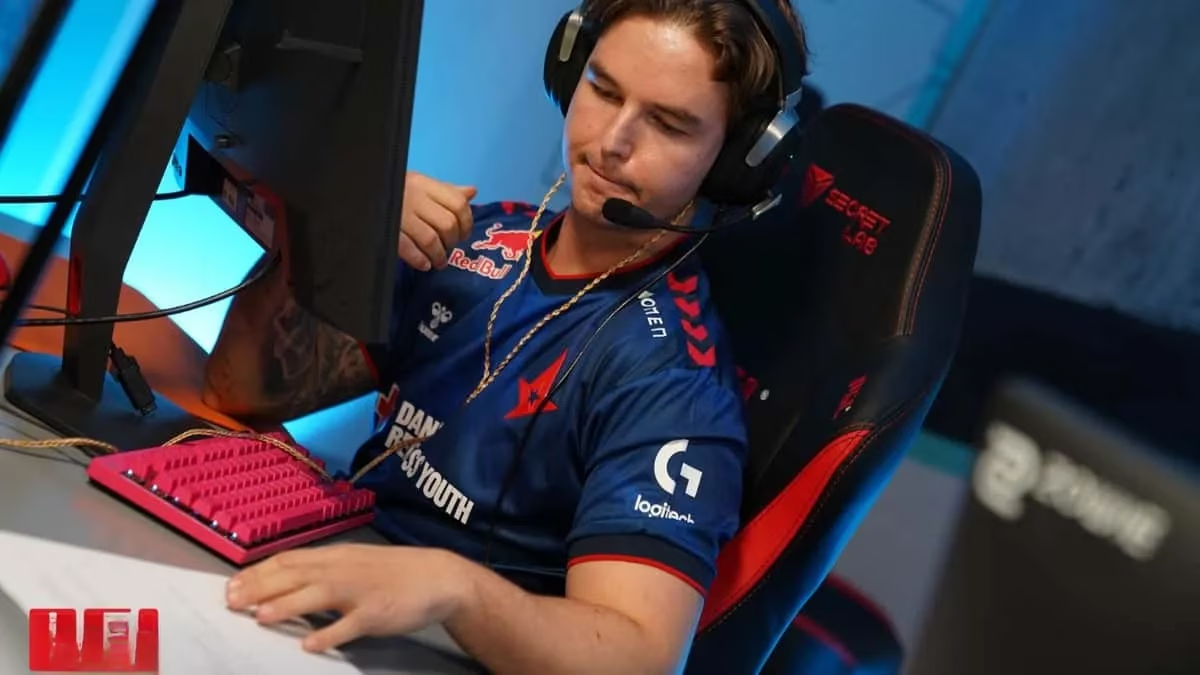
Fast forward to 2026, and that single frame of rage still sparks debates. Why hasn’t the frustration subsided? Because while the competitive scene has moved on, the ghosts of CS2’s technical instability continue to lurk in every LAN event, every online qualifier, and every clutch moment that could go up in a puff of binary smoke.
💢 The Infamous Round: What Really Happened
The setting: IEM Chengdu 2024, a crucial elimination match with Astralis fighting to keep their tournament run alive. dev1ce, widely regarded as one of the most prolific Awpers and the cornerstone of Astralis’ historical dominance, was holding a pivotal angle. He missed a shot – not ideal, but recoverable. Then came the real tragedy.
As he turned to reposition, Counter-Strike 2 simply crashed. No freeze warning, no graceful disconnection. Just a black screen and a character standing motionless, an easy frag for the opposing team. HLTV’s Luis Mira confirmed with ESL officials that it was indeed a game crash, not a hardware fault. The resulting elimination was the catalyst for dev1ce’s infamous monitor punch – an outburst that shocked fans who had only ever seen the stoic Dane celebrate with the AWP in his hands, never destroy equipment.
Later, dev1ce reflected on social media: “Couldn’t keep my cool after the game crash in that round but overall pretty good showing here in Chengdu. GGWP.” But the damage was done – both to his hardware and to the growing narrative that CS2 was broken.
And dev1ce wasn’t alone in suffering that day. Earlier in the match, FaZe Clan’s broky had encountered a bizarre spinning bug that left his character rotating uncontrollably, the confusion clear on his face during the replay. Fortunately, that glitch triggered only after the round ended, but it added fuel to the fire. CS2’s debut year was turning into a horror show of game-breaking bugs at the worst possible moments.
🐞 CS2’s Technical State: A Timeline of Tilt
Counter-Strike 2 launched in late 2023 with massive hype – new Source 2 engine, overhauled maps, volumetric smokes – but it quickly developed a reputation for instability. The IEM Chengdu disaster was not an isolated incident; it became emblematic of a larger pattern:
| Date | Tournament | Bug/Crash | Victim |
|---|---|---|---|
| Sep 2023 | CS2 Beta | Frequent game crashes | Multiple pros |
| Nov 2023 | PGL Major Copenhagen Qualifiers | Random disconnects | Various teams |
| Mar 2024 | Intel Extreme Masters Katowice | Audio glitches & stuttering | Several players |
| Apr 2024 | IEM Chengdu | Game crash, spin bug | dev1ce, broky |
| Jun 2024 | BLAST Premier Spring Final | Smokes not rendering properly | NIP, Vitality |
| Oct 2024 | ESL Pro League S20 | Tickling server lag | Entire lobby |
| Feb 2025 | IEM Dallas | Network drops mid-round | Liquidity team |
| Jul 2025 | PGL Major Copenhagen 2025 | Collision bug causing stuck players | Heroic |
| Nov 2025 | BLAST World Final | Flashbang visual corruption | FaZe |
| Mar 2026 | IEM Chengdu 2026 (yes, again) | Brief client crash, but improved recovery | MOUZ |
Even in 2026, while stability patches have reduced the frequency of catastrophic crashes, the pause rule gap remains a glaring frustration. Unlike League of Legends or Valorant, CS2 does not allow individual teams to pause mid-round for technical issues unless the entire lobby is affected. This means a single player’s crash – often caused by the game itself – results in an automatic disadvantage, a round loss, and shattered morale.
🔫 Why dev1ce’s Rage Resonated So Deeply
dev1ce isn’t known for emotional outbursts. The four-time Major champion built his legacy on ice-cold composure and mechanical perfection with the AWP. When someone that methodical loses control, it tells you something profound about the competitive environment. The monitor punch became a symbol for every professional player who felt their career could be derailed by a random engine hiccup.
From a psychological perspective, professional players train thousands of hours to eliminate variables. Flawless crosshair placement, recoil control, map knowledge – all designed to create consistency. When an uncontrollable variable like a crash steals a round, it undermines the very essence of competitive integrity. For dev1ce, that crash during a do-or-die moment was proof that the software layer still held too much power.
In the months following IEM Chengdu 2024, the incident sparked heated discussions across Reddit, HLTV, and X (formerly Twitter). Memes flooded timelines with captions like “When you’ve had enough of the Source 2 spaghetti code” or “dev1ce uninstalled CS2 for real this time.” But beneath the humor was a real demand for change.
🛠️ What Valve Did (and Didn’t Do) by 2026
Valve’s approach to fixing CS2 has been typically Valve – quiet, iterative, and sometimes maddeningly slow. Let’s look at the improvements and the lingering pain points:
✅ Major stability updates (2024-2025): Multiple patches targeted memory leaks and rendering crashes. The number of mid-round crashes on LAN dropped by an estimated 70% according to community trackers.
✅ New “Recovery Ping” feature (mid-2025): In the event of a client freeze, the server now sends a diagnostic ping. If the issue is server-side, the round can be rolled back. Not perfect, but a step.
❌ No individualized pause button: Teams still cannot call a technical pause mid-round. This is especially brutal for AWPers who often lose crucial hold angles.
❌ Spin bug still occurs in specific hardware configurations: While rarer, it hasn’t been fully eliminated, particularly on some AMD GPU models.
✅ Anti-cheat improvements: Crashes caused by third-party software conflicts are less common now, which indirectly protects pro-level setups.
❌ Lack of transparency: Players and coaches frequently complain that they don’t know if Valve is prioritizing these issues over cosmetic updates.
In 2026, the scene has adapted with workarounds: teams now practice emergency protocols for crashes, and PCs are stress-tested before each match. But the fundamental issue – that a game can still steal a pro’s opportunity – persists.
🎯 Astralis After the Punch: A Team Transformed
The monitor punch proved a turning point for Astralis in unexpected ways. While they lost that match at IEM Chengdu 2024, the organization rallied. The incident exposed how deeply the team cared, and dev1ce’s raw emotion galvanized the roster. In the second half of 2024, Astralis made a surprising run to win the ESL Pro League Season 20, with dev1ce delivering vintage performances. Analysts noted that the frustration seemed to light a fire under the veteran.
Fast forward to early 2026, dev1ce is still competing at the highest level, though he’s dialed back his hyper-focused grinding schedule. In interviews, he occasionally jokes about the monitor incident, calling it “an expensive expression of love for the game.” Astralis has since partnered with a hardware brand, and dev1ce’s setup now includes a “crash-resistant” monitor bracket – a tongue-in-cheek sponsorship nod to that famous moment.
🌍 The Bigger Picture: Esports Integrity in a Post-CS2 World
The dev1ce punch transcended a single tournament. It became a rallying cry for esports integrity advocates who have long argued that publishers must treat competitive software as a product deserving the same rigor as traditional sports equipment. Imagine if in football, the ball randomly deflated mid-play. That’s what a CS2 crash represents.
Other titles have shown that proactive measures work. Riot Games’ Valorant swiftly implemented a pause system and robust log review. Dota 2’s ability to continue after a disconnect keeps the competitive flow intact. Counter-Strike, with its legacy status, still struggles to adopt these quality-of-life features. In 2026, voices like Thorin and Richard Lewis continue to criticize Valve’s hands-off esports management, citing dev1ce’s monitor as a cautionary tale.
😂 The Memes That Kept Us Sane
You can’t talk about the monitor punch without appreciating the memes that immortalized it:
-
“dev1ce: I’m the cleanest AWP in the world. Also dev1ce: destroys monitor”
-
Photoshopped images of dev1ce punching everything from a coffee machine to the Eiffel Tower
-
“IEM Chengdu 2024: Where Monitors Go to Die”
-
The iconic “Did you try turning it off and on again?” template with dev1ce’s face
Even Valve’s CS2 update notes once slyly referenced “improved monitor durability” – whether a direct nod or coincidence, the community loved it.
🔮 2026 and Beyond: Will CS2 Ever Be Truly Stable?
Looking ahead, the esports calendar for the rest of 2026 is packed: the CS2 Major in London, BLAST Premier World Final, and the highly anticipated IEM Season XXI global series. Each event carries the weight of potential crashes. While the community acknowledges that perfect stability is impossible, they expect a baseline. The dev1ce incident set that baseline painfully high.
Tournament organizers have adapted by running dedicated LAN builds that strip down potential failure points, but even those can’t guard against every edge case. Multiple teams now employ performance analysts whose job partly includes monitoring crash logs during practice.
In a recent FISSURE podcast, a prominent coach remarked, “We’ve moved from praying the game doesn’t crash to planning for when it does.” That shift in mentality, born from that one punch in Chengdu, is both pragmatic and disheartening.
✍️ Final Thoughts: A Punch That Echoes
Two years on, dev1ce’s monitor punch remains more than just a viral clip – it’s a permanent scar on CS2’s reputation. It exposed fragility at the highest level and forced conversations that the industry is still having. While some fixes have arrived, the core pain points of no mid-round pause and sporadic engine bugs persist, reminding us that even the most legendary players are at the mercy of code.
The next time you queue into a CS2 match in 2026, whether you’re grinding out of Silver or preparing for a LAN grand final, spare a thought for the hardware that might meet an untimely end. And remember: the real Easter egg isn’t in the game files – it’s in the emotional durability of esports athletes who keep fighting, even when the software lets them down.
GGWP, dev1ce. Maybe keep a spare monitor handy. 😄🖥️💥
Comments