The Long Road to Inclusion in Counter-Strike: Astralis Women’s Plea for Default Female Agents
The year is 2026, and a quiet but persistent question still echoes through the Counter-Strike community: why, in arguably the world’s most popular competitive first-person shooter, are there still no default female player models? The issue was thrust into the spotlight back in 2024 when the all-female Astralis Counter-Strike roster released an open letter to Valve, the game’s developer. The letter, signed by Josefine Jensen, Aurora Lyngdal, Marie Toft, Anja Soelberg, and Isabella Ferslev, was a remarkably measured yet deeply felt request for a change that should have happened long ago. It asked for female agent skins to be available as a default selection, without any additional cost, just as the male agents have always been.
The players did not demand the removal of existing paid skins or a rework of the game’s economy. Instead, they simply pointed out a fundamental imbalance. “We share the passion for Counter-Strike with millions of gamers world-wide and we love being a part of a truly global community,” the letter read. “Unfortunately, we currently feel we are only guests at the party.” The reason for that feeling was stark: every default agent in CS2 is male. Players who want to embody a female character must either have earned one during past CS:GO operations or purchase one from the community market, often at a significant cost.
It is not as though Valve lacks the assets. Female agent skins have existed in the Counter-Strike universe for years. Characters like Lieutenant Farlow, Getaway Sally, Commander Mae Jamison, Special Agent Ava, Chef d’Escadron Rouchard, and Vypa have all been released at various times, some with multiple variants. These designs prove that the developer is not only capable of creating compelling female models but has actively chosen to place them behind a paywall. A quick look at the Steam community market in 2026 reveals that the situation has barely shifted since the letter was penned. The cheapest option, Mae Jamison, still hovers around nine dollars, while the stylish Getaway Sally can command over fifty. Is it any wonder that female players might feel like an afterthought when their very presence on the battlefield is treated as a premium feature?
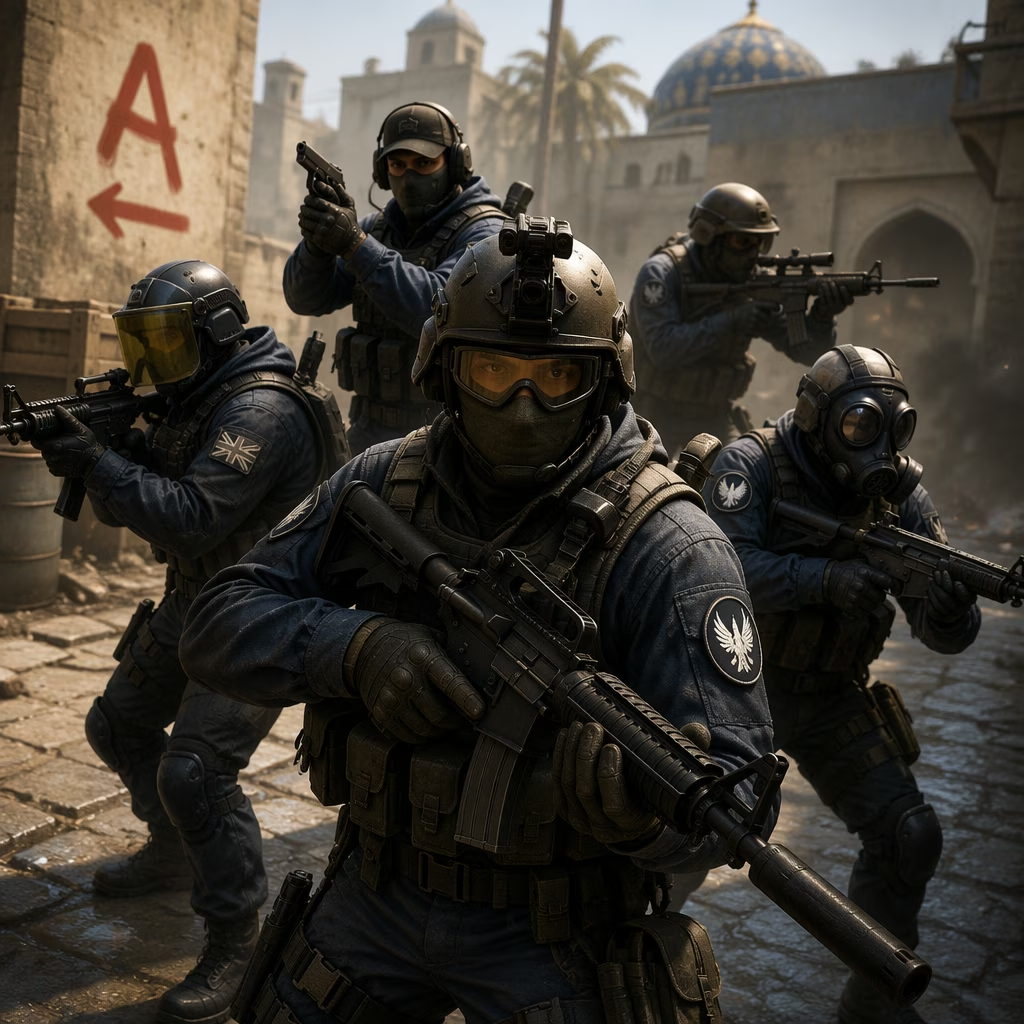
The financial barrier is only part of the problem. The Astralis letter touched on a deeper grievance: the sense of being unwelcome in a space they love. “Using a female agent skin costs extra, while default skins are all male,” Jensen wrote. “We don’t know why it is so, but we know that it strikes us as being both unfair and a bit unwelcoming. It certainly feels that way and in some way it supports the sexism that we unfortunately still encounter.” The reaction to the letter on social media and forums proved her point with depressing speed. Amid the considerable support, a torrent of dismissive and hostile comments emerged—some belittling the players’ skills, others claiming that Valve had more important priorities, and many resorting to the kind of casual misogyny that continues to plague online gaming. How can the argument that adding a default female agent is not a pressing issue coexist with the undeniable reality that its absence actively contributes to an exclusive atmosphere?
From a technical standpoint, the change is far from impossible. Valve, as one of the most respected development studios in the industry, has demonstrated ample experience designing female characters across its franchises. More importantly, the existing female agents already function within CS2 with appropriate hitboxes and animations. There is no hidden engine limitation or insurmountable design challenge that justifies keeping all default agents male. The real reason, as many observers have noted, is likely an historical hangover. Counter-Strike’s origin story is rooted in a simplistic binary: five male counter-terrorists versus five male terrorists. For years, that was simply the game’s identity, and updating a legacy title carries its own inertia.
Yet the world has moved on, and so have expectations for representation. In 2026, the absence of free female agents feels less like a nostalgic quirk and more like a glaring omission. The Astralis players acknowledged that some people scoff at the idea that a simple character model could attract more women to the game, but their reply is unassailable: “at least those of us playing now would feel more welcome.” This is the crux of the matter. Adding a few default female agents—casual, everyday counterparts to the male defaults, as Jensen suggested—would cost Valve almost nothing and could meaningfully improve the daily experience of thousands of players. It is a change so small that its continued absence invites uncomfortable questions.
To date, no official response from Valve has arrived. When Jensen was asked about the letter two years ago, she confirmed that they had not received a reply and were still waiting. Since then, the developer has remained characteristically silent on the matter. The thread of unanswered correspondence ties back to an earlier attempt to reach the company in January of 2024, which also went nowhere. It is a pattern familiar to anyone who has followed Valve’s opaque communication style: a wall of quiet that leaves communities wondering whether their voices are even heard.
That silence, however, has not stifled the conversation. Support for the idea has only grown over time, driven in part by the Astralis team’s courage in speaking out. Each time the topic resurfaces on community hubs or social platforms, new voices add their weight to the call for parity. There is a slow-burning recognition that fairness in representation is not a niche concern but a fundamental aspect of a game that bills itself as a home for millions.
The open letter concluded with a simple, powerful line: “There should be no difference between agents. There should be as many free female agents as free male agents.” In 2026, that sentence still resonates. It asks not for special treatment, but for an end to a quiet, ingrained disparity. The ball remains in Valve’s court. Will the developer finally address this in a future update, or will the default Counter-Strike experience remain frozen in a time when only one kind of player was imagined on the server? The answer, like so much about Valve’s plans, remains frustratingly out of sight—but the question will not go away.
Comments