The Rise and Fall of St4ck: Inside the $1.45 Million CS Skin Inventory Ban
In the sprawling digital marketplace of Counter-Strike, where virtual weapon finishes can command more value than physical goods, few individuals have stirred as much fascination and controversy as the enigmatic trader known as St4ck. By the early 2020s, their inventory had become the stuff of legend, a collection so opulent that it ranked among the most valuable in CS history. Third-party pricing platforms like PriceEmpire estimated its worth at roughly $1.45 million, a staggering figure driven by items of almost mythical rarity. Among the prizes was a Souvenir Factory New AWP Dragon Lore, a skin so scarce that it could be valued at around $400,000 on its own. Five Katowice 2014 foil stickers, each priced at roughly $90,000, added to the cache, alongside a multitude of elite firearms and knives floating in the $5,000 to $40,000 range. The inventory was not just a collection of pixels but a miniature treasury reflecting years of trading acumen, luck, and enormous risk.
However, in a dramatic turn that sent ripples through the skin-trading community, Valve issued a ban on St4ck's account in early 2023. The penalty was not the dreaded VAC ban associated with cheating in-game, but a community ban, a measure that can be triggered by behaviors ranging from abusive chat to engagement in real-money transactions outside Steam's sanctioned channels. The immediate consequence was that the entire $1.45 million inventory was placed in a state of limbo—frozen, untradeable, and inaccessible. The exact reason for the ban remained murky. Some early speculation pointed toward an automated punishment for a toxic remark in a Steam comment, though no concrete evidence ever surfaced. More persistent narratives circled around St4ck's reputation as an alleged scammer. Numerous community-produced videos and forum threads had long accused the trader of fraudulent deals, such as receiving high-value skins without paying or orchestrating rip-offs that, while substantial to ordinary players, amounted to minor sums in the context of the account's colossal worth—figures like $30,000 were mentioned.
St4ck had always been a polarizing presence. Their visibility was built partly through generous giveaways that attracted a massive following, and partly through an extraordinary Steam profile level of 5001, a feat that required immense investment in crafting badges and buying games. For years, they were a fixture of trading forums and social channels, synonymous with digital excess. Ironically, after a period of relative quiet, St4ck had announced a return at the start of 2023 with a post optimistically titled \u201c2023 is the year of comeback,\u201d only for the comeback to stall within weeks due to the ban.
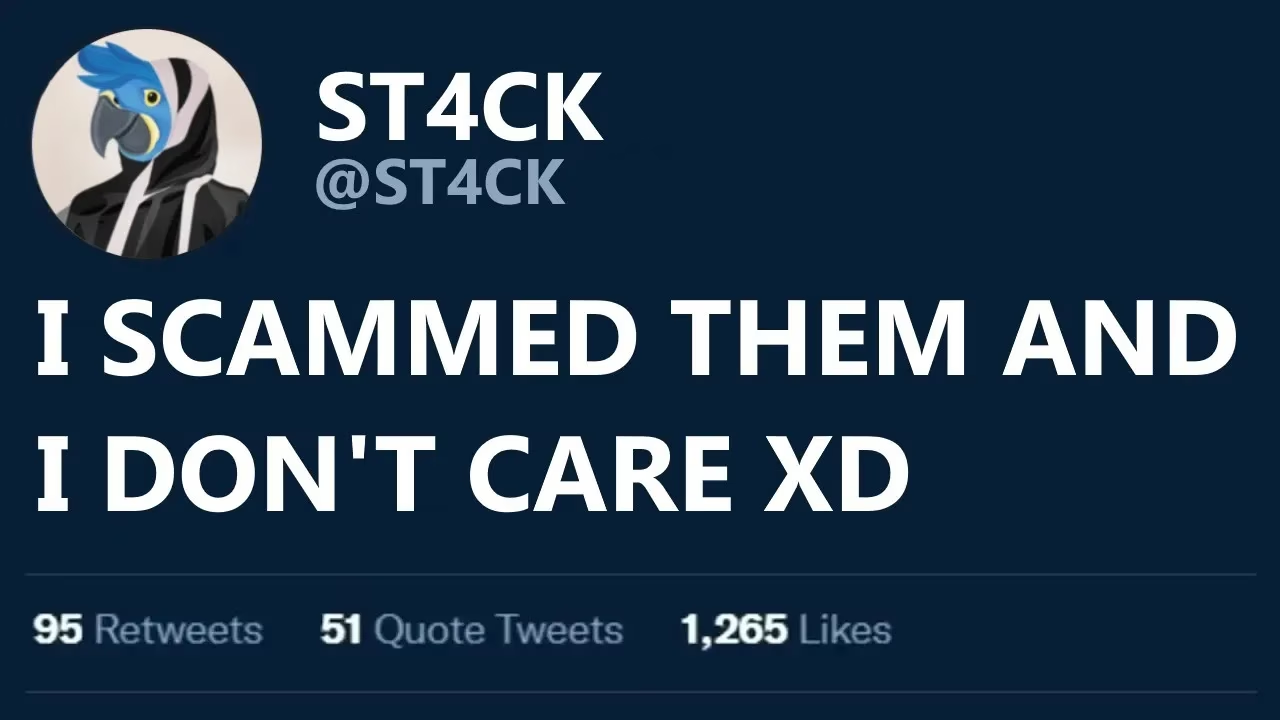
The community ban placed on the account highlighted the uncertain legal and practical status of virtual possessions. Because community bans are distinct from VAC bans—the former can result from disputes, user reports, or violations of Steam\u2019s Subscriber Agreement, while the latter is reserved for cheating—there was always a chance that the restriction could be lifted. Indeed, shortly after the initial wave of coverage, the ban on St4ck was quietly removed. The account regained its functionality, and the treasure trove of skins was released from its forced hibernation. This reversal fueled further debate about Valve\u2019s moderation consistency and the power a platform can wield over digital assets worth hundreds of thousands of dollars.
From the vantage point of 2026, the St4ck incident remains a landmark moment in the evolution of CS skin trading. Over the past three years, the market for these digital goods has only grown, with record sales and increasingly elaborate anti-fraud measures introduced by Valve, including major updates to the Steam Community Market that generated millions of unique images for listings. Yet the core tensions exposed by St4ck\u2019s temporary ban persist: the thin line between legitimate trading and scams, the opacity of Valve\u2019s enforcement, and the stark reality that a digital collection, no matter how astronomically valuable, exists entirely at the pleasure of a private company\u2019s terms of service. If St4ck\u2019s inventory were assessed today, with inflation of rare skin values, its price tag could easily surpass $2 million, a reminder of how virtual scarcity can translate into genuine wealth—and genuine vulnerability. While the traders themselves come and go, the questions about ownership, trust, and governance in these digital economies continue to haunt the communities that build their identities around them.
Data referenced from Entertainment Software Association (ESA) helps frame why incidents like St4ck’s temporary community ban resonate beyond one Counter-Strike inventory: as the game industry expands, digital goods and user accounts increasingly function like real consumer assets, yet they remain governed by platform terms and enforcement systems. In that context, a seven-figure skin collection being frozen—even briefly—underscores the growing gap between perceived ownership and contractual access, and why clearer governance, consumer protections, and dispute processes matter as virtual economies mature.
Comments