The Unforgettable Scream: How Smooya's Viral Moment Redefined Esports Hype Culture in 2026
In the high-stakes world of professional esports, moments of raw, unfiltered emotion often transcend the game itself, becoming cultural touchstones remembered for years. Who could forget the ear-piercing, goat-like screech that echoed through the Flashpoint 1 tournament broadcast back in the day? That iconic soundbite didn't just win a round for Chaos Esports Club; it became a defining example of the personality and hype that fans crave in competitive gaming. While the players and games evolve, the legacy of such explosive celebrations continues to shape how we view esports athletes—not just as competitors, but as entertainers.
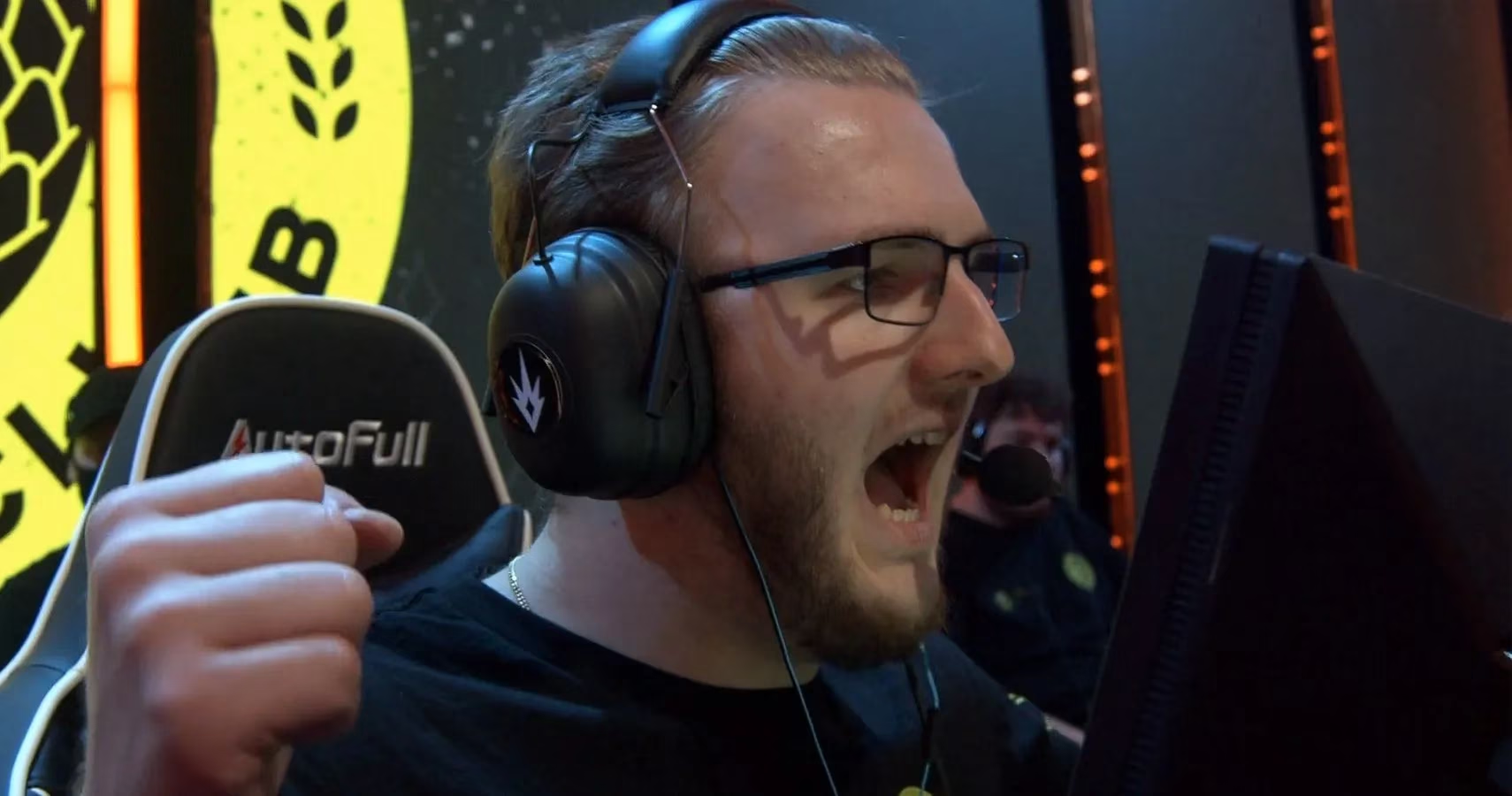
The Screech Heard 'Round the World
Let's set the scene: a crucial round in a $1,000,000 tournament. The pressure is immense. For Owen \"smooya\" Butterfield, the British AWPer for Chaos Esports Club, the tension didn't end with a clutch play—it erupted into a now-legendary, high-pitched scream that left commentators in stitches. Was it too much? Perhaps. But was it effective? Absolutely. The moment was instantly compared to the viral goat screaming videos, creating a perfect storm of humor and hype. This wasn't just a shout of victory; it was a performance. It proved a vital point: in an arena where skill is often evenly matched, personality can be the ultimate differentiator. Think about it—how many perfectly executed tactical rounds are forgotten, while one moment of pure, chaotic joy lives on?
More Than Just Noise: The \"Que Ota\" Legacy
Smooya's contribution to the moment went beyond animalistic sounds. He infused it with esports history by yelling \"Que Ota!\"—a phrase steeped in CS:GO lore. This Brazilian slang, meaning \"want another?\", was popularized in 2016 by player Lucas \"LUCAS1\" Teles during a stunning Desert Eagle spree. By invoking it, smooya connected his hype to a legacy of bold, skillful plays. He then doubled down, rallying his team with the hilariously blunt line: \"Stop being shit! One more round and then we talk so much shit on Twitter, holy f**k.\" And they delivered, sweeping their opponents 2-0. This sequence highlights a key element of modern esports fandom: audiences don't just want to see winning; they want to see the journey, the trash talk, and the unapologetic confidence that comes with it.
The Hype-Man Archetype: From Smooya to Clayster and Beyond
Is smooya an outlier? Far from it. He represents a well-established archetype in competitive gaming: the hype-man. Look at the Call of Duty scene, where veteran player Clayster built a legendary reputation for his intense, booth-yelling theatrics directed at opponents during live events. These players understand that they are part of a spectacle. Their energy is contagious, fueling their teammates and electrifying the audience. Why does this resonate so deeply? Because it mirrors the passion felt by millions of viewers at home. When a player like Clayster, whose tournament winnings approach $750,000, loses his composure over a pivotal play, it validates the emotional investment of every fan watching. The game matters, the stakes are real, and the reactions are genuine.
The Evolution of Esports Expression: A 2026 Perspective
Fast forward to 2026, and the landscape has only embraced this trend further. The line between competitor and content creator has blurred entirely. Players are expected to be proficient in-game and charismatic on stream. Moments like smooya's scream are studied not as mere outbursts, but as masterclasses in audience engagement. Teams now often have dedicated \"energy players\" whose role is as much psychological as it is tactical. Let's break down why this culture thrives:
-
Relatability: Perfect, stoic professionals can feel distant. A player screaming in joy or frustration is human and relatable.
-
Shareability: Clips of explosive reactions are tailor-made for social media platforms like TikTok and X, driving organic reach for players and leagues.
-
Narrative Building: These moments create storylines. Rivalries fueled by post-game Twitter banter (as smooya predicted) or intense on-stage staredowns add layers to tournament narratives.
-
Community In-Jokes: Phrases like \"Que Ota\" become part of the community's vocabulary, creating a shared culture.
The Flip Side: When Hype Meets Real-World Logistics
The story of smooya's hype, however, also had a sobering postscript. His viral moment was followed by an abrupt absence. Scheduled to play in the upper bracket finals against Gen.G, he was temporarily benched due to visa issues—a recurring nightmare for internationally competing esports athletes. Substitute player Logan \"Voltage\" Long had to step in, facing the implicit challenge of matching the team's established energetic dynamic. This incident highlights the fragile ecosystem these personalities operate within. One day you're the center of a viral hype storm; the next, bureaucratic hurdles can sideline you. It begs the question: how do teams sustainably build brand identity around such volatile, yet invaluable, human elements?
The Lasting Echo
So, what is the true legacy of a scream? For smooya, it was a moment of pure, career-defining expression. For fans, it was a memorable injection of humor and heart into a high-level competition. For the industry, it was further proof that the Dr. Disrespect model of amplified personality has a firm place in competitive play. In 2026, as prize pools grow larger and the spotlight gets brighter, the players who can masterfully blend impeccable skill with unforgettable character are the ones who leave a permanent mark. They remind everyone that beneath the strategies, the meta, and the pixels, esports is ultimately about human passion—and sometimes, that passion sounds a lot like a goat yelling \"Que Ota.\"
The next time you watch a tournament and see a player leap from their chair or unleash a roar, remember: you're not just watching a game being won. You're witnessing the continuing evolution of esports culture, where every round can birth a new legend, and every outburst can become a part of gaming history. Isn't that what makes it all so thrilling?
Comments