Valve’s New CS2 Loot Boxes: Free to Open, Painful to Claim
I’ve been deep in Counter-Strike 2 ever since the beta days, chasing frags and tweaking my crosshair like a neurotic artist. So when Valve rolled out the Genesis Terminal system back in September 2025, I felt a familiar tingle — the same one I get when I hear the distant jingle of an ice cream truck, except this truck might sell me a $1,600 pistol skin. On the surface, the Genesis Terminal looks like a gift from the gaming gods: one free loot box per week, purely because you exist. No key purchase, no initial buy-in. It’s as if a casino handed you a free spin on a slot machine and whispered, “No strings attached.” But strings there are, and they’re woven from pure FOMO.
When you interact with the Genesis Uplink Terminal in-game, the system presents you with one skin at a time. You can either accept it and pay the displayed price, or decline it forever to see the next option. There’s no going back. It’s a push-your-luck minigame wrapped in a psychological stress test. Do I settle for that decent M4A4 camo listed at $2.50, or do I gamble on the chance of revealing a coveted AK-47 skin? The second choice might show me a boring MP9 for $0.30 — a disappointment that stings like finding a single cold fry at the bottom of the bag. But occasionally, it reveals a hyper-rare skin with a four-digit price tag. One player famously shared a screenshot of a $1,600 bill for a single cosmetic, captioning it with language that would make a sailor blush. That’s not a typo. You don’t “win” the skin; you win the right to buy it directly from Valve.
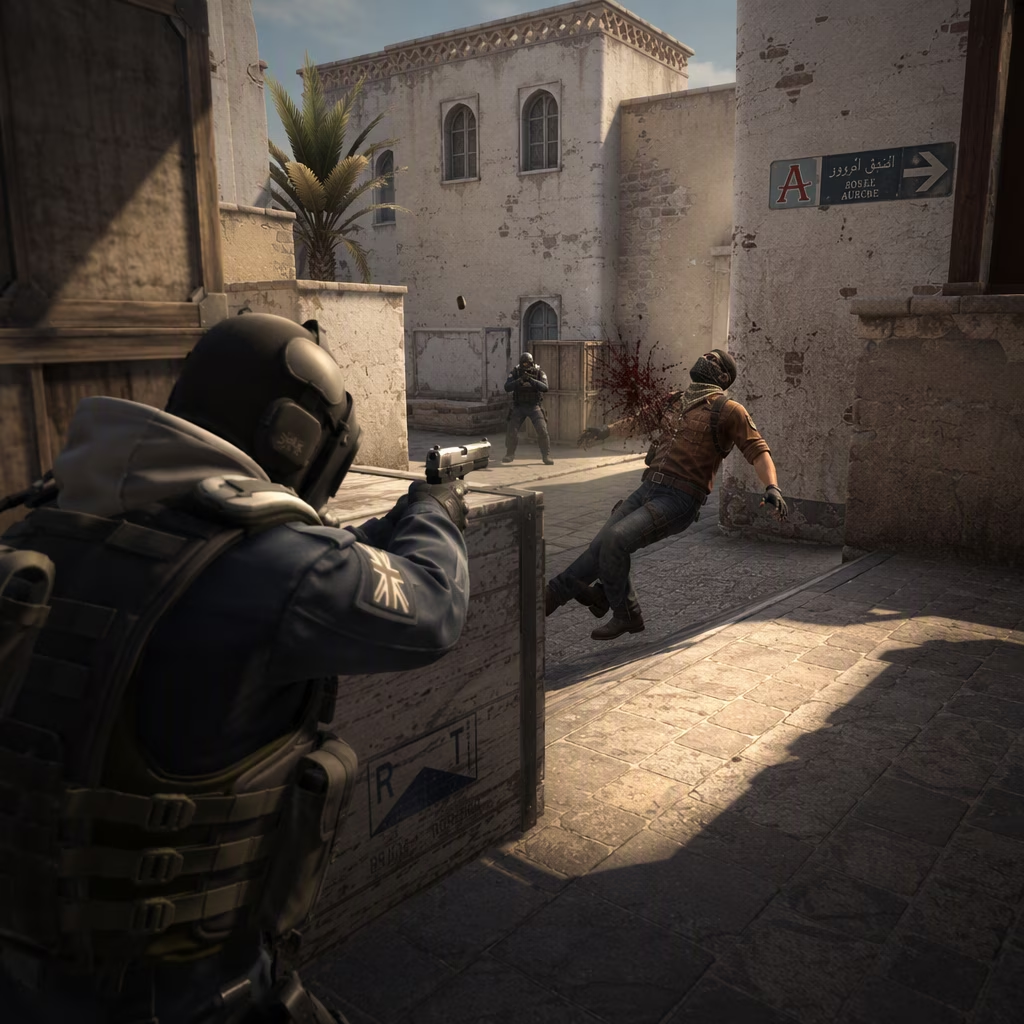
This mechanism is a clever legal sidestep around anti-gambling regulations that have been tightening across Europe. Countries like Belgium, the Netherlands, and France banned traditional loot boxes because you pay before seeing what you get — it’s blind chance, just like pulling the lever on a one-armed bandit. Valve’s stroke of genius here is reversing the sequence: you see the item first, then decide whether to pay. The official patch notes even announced that players in those EU countries can now “unseal their Sealed Genesis Terminal items.” It’s compliant on paper because you’re not buying a mystery; you’re buying a specific product that happens to be revealed through randomization. Think of it as a restaurant where the waiter brings you a random dish, lifts the cloche, and says, “You can eat this for a price, or I’ll bring another, but you can’t order the one you just rejected.” You haven’t bet anything yet, but the emotional stakes are already sky-high.
From a player’s perspective, the experience is a masterclass in manufactured urgency. You have three days to claim your weekly box, and once you start that terminal session, the countdown to make a decision feels like a lit fuse. I’ve watched friends agonize over whether to take a $12 AWP skin or risk losing it for something better, and the anxiety is palpable. It’s like holding a bird in your hand: you can squeeze to keep it or open your palm hoping a more colorful one lands — and the one you release vanishes into the trees forever. The community response hasn’t exactly been a standing ovation. Discussions on forums are peppered with phrases like “greedy fucks” and “item shop somehow worse than gambling.” Valve’s defenders point out that you can sell acquired skins on the Steam Community Market after a week, but that’s a weak safety net. Market prices fluctuate wildly, and there’s no promise you’ll recoup even a fraction of what you paid to unlock a skin in the first place. A $1,600 purchase might fetch $800 after a month, and by then you’ll have spent a car payment on virtual gun paint.
What makes this system so insidious isn’t the legal loophole — it’s the way it weaponizes our own psychology. Traditional loot boxes are a gamble you pay for upfront, and losing just means getting a duplicate or ugly skin you can discard. Genesis Terminals flip the script into a montage of near misses and “what ifs.” Every decline you make echoes in your head: Should I have stopped there? By the end of the chain, you’re often presented with something mediocre, and there’s no reset button. You walk away either empty-handed or with a skin you’ll resent every time you see it in your inventory. It reminds me of a rigged claw machine where the prizes are paraded one by one, and the operator laughs as you press the “next” button until the final prize is a plastic keychain you could buy at a dollar store.
I can’t help but admire the sheer audacity of the design. Valve has been tiptoeing around loot box restrictions since 2019, when they gave French players a scanner that revealed box contents before purchase — but forced them to buy the revealed item before scanning again. The Genesis Terminal feels like the evolved form of that idea: a slow-drip cinema of skins where you’re the protagonist paying admission with every click. As someone who loves CS2 for its precise gunplay and tactical depth, seeing skins increasingly dominate the conversation is bittersweet. I get the cosmetic dopamine hit, but when microtransactions balloon into $1,000+ decisions, we’ve entered a realm where the term “micro” has lost all meaning. It’s macrotransaction territory, and it’s creeping into my gaming headspace like an invasive species. I’ll still open my weekly terminal, of course — because the lure of a free peek is almost impossible to ignore — but I’m bracing myself for the day my dream skin appears and the price tag makes me spit out my coffee.
Comments